Sung-Won Yang offered performances loaded with imagination, technical brilliance and pinpoint accuracy in intonation. Contours were skillfully shaped, scalar nuances were crafted with exquisite care and the whole rang with a resounding richness.
-Washington Post-
…an immensely accomplished artist with a huge sound and a way of playing that is lyrical and intense without a hint of preciousness.
-The Sunday Times-
It takes a player of Sung-Won Yang’s Technical Brilliance and expressive boldness to make one feel The Kodaly’s Solo Sonata’s full grandeur.
-Gramophone-
Sung-Won Yang is a cellist of rare depth and breadth, whose artistry brings together intellectual clarity, poetic intensity, and an unwavering belief in music as a vital human force. He has appeared on many of the world’s most revered stages, including the Salle Pleyel and Théâtre des Champs-Élysées in Paris, the Concertgebouw in Amsterdam, the Musikverein in Vienna, Alice Tully Hall at Lincoln Center in New York, and Suntory Hall in Tokyo.
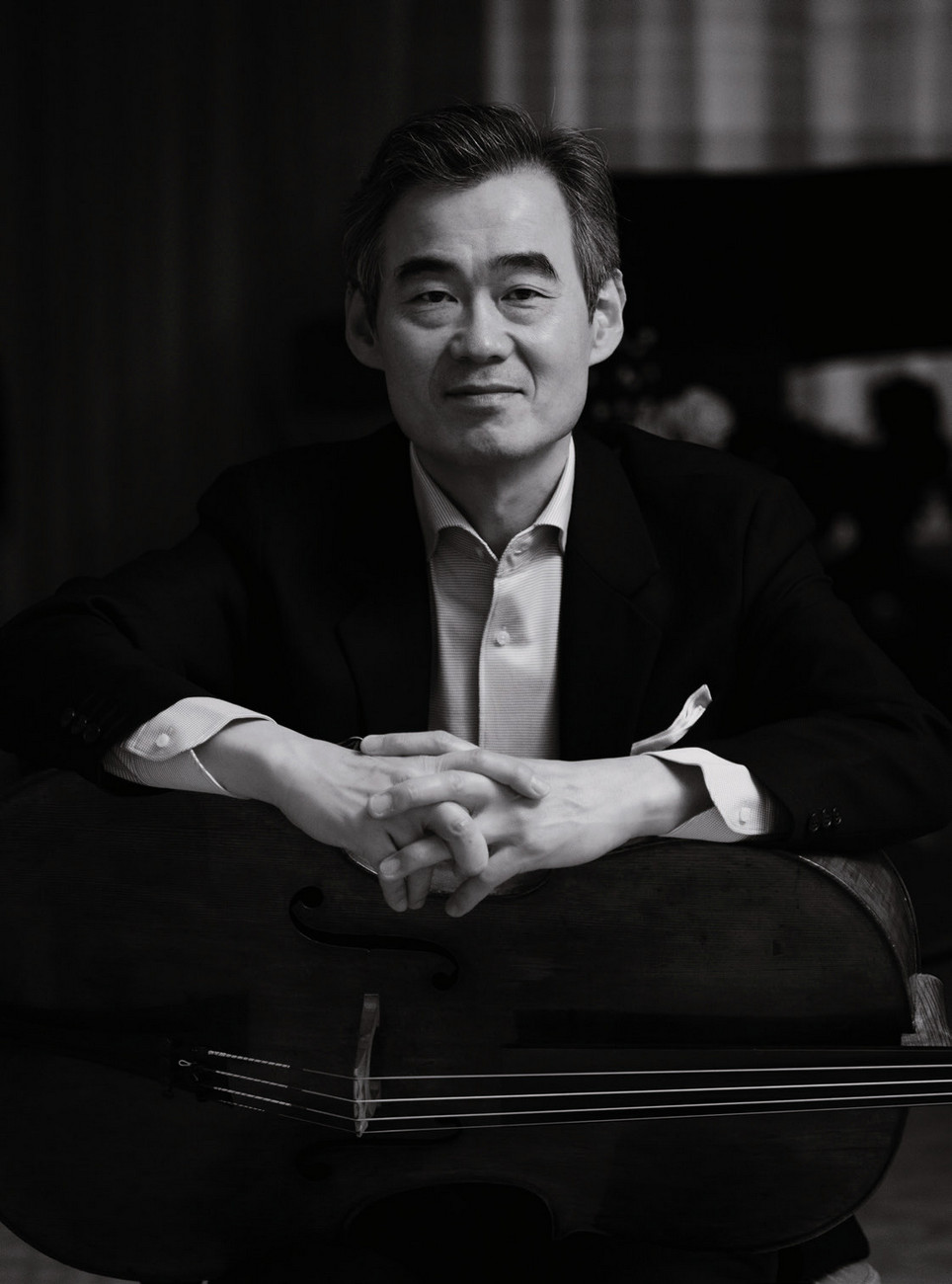
A long-standing recording artist with Decca/Universal Music, his discography reflects both a profound engagement with the core repertoire and a curiosity that reaches beyond it. Recent releases include Schumann’s Cello Concerto with the London Symphony Orchestra under Hans Graf (2024), and an Elgar album pairing the Cello Concerto with the Piano Quintet, released in 2025. His earlier recordings range from Bach and Beethoven to Brahms, Schumann, Messiaen, and Kodály — the latter earning both Gramophone Editor’s Choice and Critic’s Choice of the Year. In 2026, a recording of Haydn’s Cello Concertos with Thomas Zehetmair and the Orchestre National d’Auvergne Rhône‑Alpes will be released, continuing his exploration of classical clarity through a modern sensibility.
Chamber music lies at the heart of his musical life. He enjoys a long-standing partnership with pianist Enrico Pace, with whom he has recorded works by Liszt, Chopin, Beethoven, Schumann, and Brahms. He is also a founding member of Trio Owon, alongside violinist Olivier Charlier and pianist Emmanuel Strosser, an ensemble praised for its organic unity and stylistic breadth, with recordings spanning Schubert, Dvořák, Beethoven, Messiaen, Tchaikovsky, and Weinberg. His musical collaborations further include performances with artists such as Zdeněk Mácal, Miklós Perényi, Peter Eötvös, Myung‑Whun Chung, and Christoph Eschenbach.
Deeply engaged with the music of our time, Sung-Won Yang is a committed advocate for contemporary creation. He has commissioned and premiered works by composers including Peter Eötvös, Jee-Young Kim, Laurent Petitgirard, and Nicola Sani, and will soon premiere a new work dedicated to him and Enrico Pace by Eric Montalbetti. His interest in dialogue between music and history also led him, in 2016, to produce a documentary honoring young French priests martyred in 19th-century Korea — a project intertwining memory, faith, and cultural heritage.
Born in Korea, Sung-Won Yang studied at the Conservatoire National Supérieur de Musique de Paris and later served as assistant to the legendary János Starker at Indiana University. He is regularly invited to serve on juries for major international competitions, including the Banff International String Quartet Competition, the Cassadó International Cello Competition, the André Navarra International Cello Competition, and the Osaka International Music Competition.
Alongside his performing career, he is deeply invested in shaping musical life through vision and mentorship. He serves as Artistic Director of the Music in PyeongChang in Korea and the Festival Beethoven de Beaune, where his programming seeks to connect heritage and innovation while fostering genuine dialogue between artists, audiences, and society. He is a Professor at Yonsei University in Seoul and a Visiting Professor at the Royal Academy of Music.
A Chevalier des Arts et des Lettres of the French Republic and recipient of the Order of Cultural Merit from the Korean government, Sung-Won Yang remains guided by a conviction articulated by Victor Hugo: “Music expresses that which cannot be put into words and that which cannot remain silent.” Like Beethoven — a lifelong point of reference for him — he believes music speaks most powerfully where language reaches its limits.
Through his recordings, performances, festivals, and teaching, Sung-Won Yang continues to shape a musical path rooted in depth, transmission, and the quiet urgency of human expression.
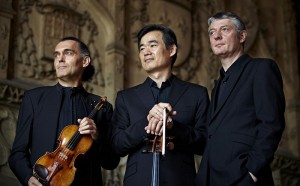
In 2009 Sung-Won Yang creates the Trio Owon with violinist Olivier Charlier et pianist Emmanuel Strosser, from the merger of three musicians from the Paris Conservatory, united by the same passion for chamber music. Their goal is to share with its audience a fully integrated vision of music, committed by a group without boundaries, resulting from a rich and varied artistic inspiration. Through concerts and recordings in England, France, and Korea, Trio Owon already stated its identity made of passion and maturity, like the painter whose name they bear. Painter of Nature, emotion and poetry, OHWON Jang Seung Up, embodies for the trio Owon the universal dimension of Art. Contemporary of Brahms, but from a completely different aesthetic world, it symbolizes the quest of an ideal result of tradition and renewal in the nineteenth century Korea. His story brought to the cinema (Strokes of Fire, prized at Festival de Cannes in 2002), reveals the doubts and commitments of an undaunted artist. Beyond the anecdote (his name’s sound summarizes some of our three first names…) here it symbolizes the osmosis between knowledge and modernity.
Sung-Won Yang plays Versum Solo strings.